Showing posts with label Bengal. Show all posts

Monday, August 27, 2012

Silent History: Murshidabad

There are events which change rulers, which change lives of people. And then here are events which change the course of a nation's history. There are places which are loud on every page of our history books. Then there are places which remain silent witnesses of the stories of treachery, of greed, of shame and survive ages. The Battle of Plassey is one such event and Murshidabad is one such place. I am no expert in history but I sure am intrigued what made us the nation we are now.

NH-34 is a highway only by its name. But the company of Kushanava, Debsathi, Sugata and Mousumi made the bumps and pits a little more bearable. Reaching the hotel at 1am is no walk (drive) in the park. But once there, the crew instantly chose to take a power nap for the day ahead.
Initially a guide-less roaming was proving to be irritating, but when we finally got a professional guide with us, the not-to-scale map printed on the back of our hotel's menu card found a place somewhere which no one remembered after that. First in our list was MOTIJHEEL and KALA MASJID.
The 'jheel' or a lake (not in picture here) is a horse-shoe shaped one and was actually custom-shaped for the protection of the queen of a Nawab here. Also, it was used to cultivate pearls. There was a signboard erected here saying: "The cultivation was done by trained professional and not morons, so do not try it at home." (Just kidding!).
There is an intriguing story about a hidden treasure in this mosque's premises. It is said that once a British officer discovered that there is a treasure locked up in an entry-exitless compartment inside the thick boundary wall of this mosque. He tried and cannon out the treasure one day but failed to reach the required depth inside that brick wall. On the very next morning, he died of spitting blood. I don't know how much true is the 'story' but we all saw that two century old cannon hole in the wall. It is still untouched.

Moving up that heated up day, we reached a very interesting piece of metal work. The JAHAN KOSHA CANNON. When we reached this place, it appeared a bit odd to find something important like this left open in the sun. But after touching the body of this 22 feet long devil, I came to know why. It wasn't freakishly hot like the iron grills surrounding its platform. It had a soothing warm heat all over it. Made out of an alloy of eight metals like iron, copper, gold etc., it is one of its kind. Imported from Dhaka (present Bangladesh), this cannon has a shot range of 6 miles (same as the radius of the atom bomb in the movie The Dark Knight Rises)
Actually, this was not my first visit to Murshidabad. I had been there about 11 years back, when I had just taken my std 10th board exams. At KATRA MASJID I was missing a camera very badly  in my hands back then. And even today, I could not forget that. I was glad that few of the shot which were just a blink of the eyes of that teenage boy then are now a proper jpeg files.
This mosque was build by Murshid Kuli Khan, the grandfather of the last free Nawab of Bengal, Siraj ud-Daula. It has a prayer area which can accommodate 5000 namazis at the same time.
During the last days of Murshid Kuli Khan, he started to go down the remorse alley. With all the religious and political torture he made his people go through, he realized that the only way to his salvation is their forgiveness. He made the arrangement of his own tomb under the staircase of the doorway though which Namazis were to enter and exit the mosque, so that the dust from their feet may fall on his tomb and he may gradually be delivered from his sins.

And where there is a Nawab, the business of luxury finds its way in spite of all odds. Four brothers from far away Rajasthan came down to Bengal to trade the exotic scent of the Kath Golap, the wooden rose.
From the name of the flower, the area came to be known as KATHGOLA. Now totally extinct from the area, this was a rare rose with the colour of wood. They made a splurge palace in the north of Lalbagh with a signature Marwari bathing arrangement.

Within the boundary of their palace, there is a temple called PARESH NATH TEMPLE which houses an idol of Paresh Nath, the first disciple of the fouder of Jainism - Mahavir Jain.
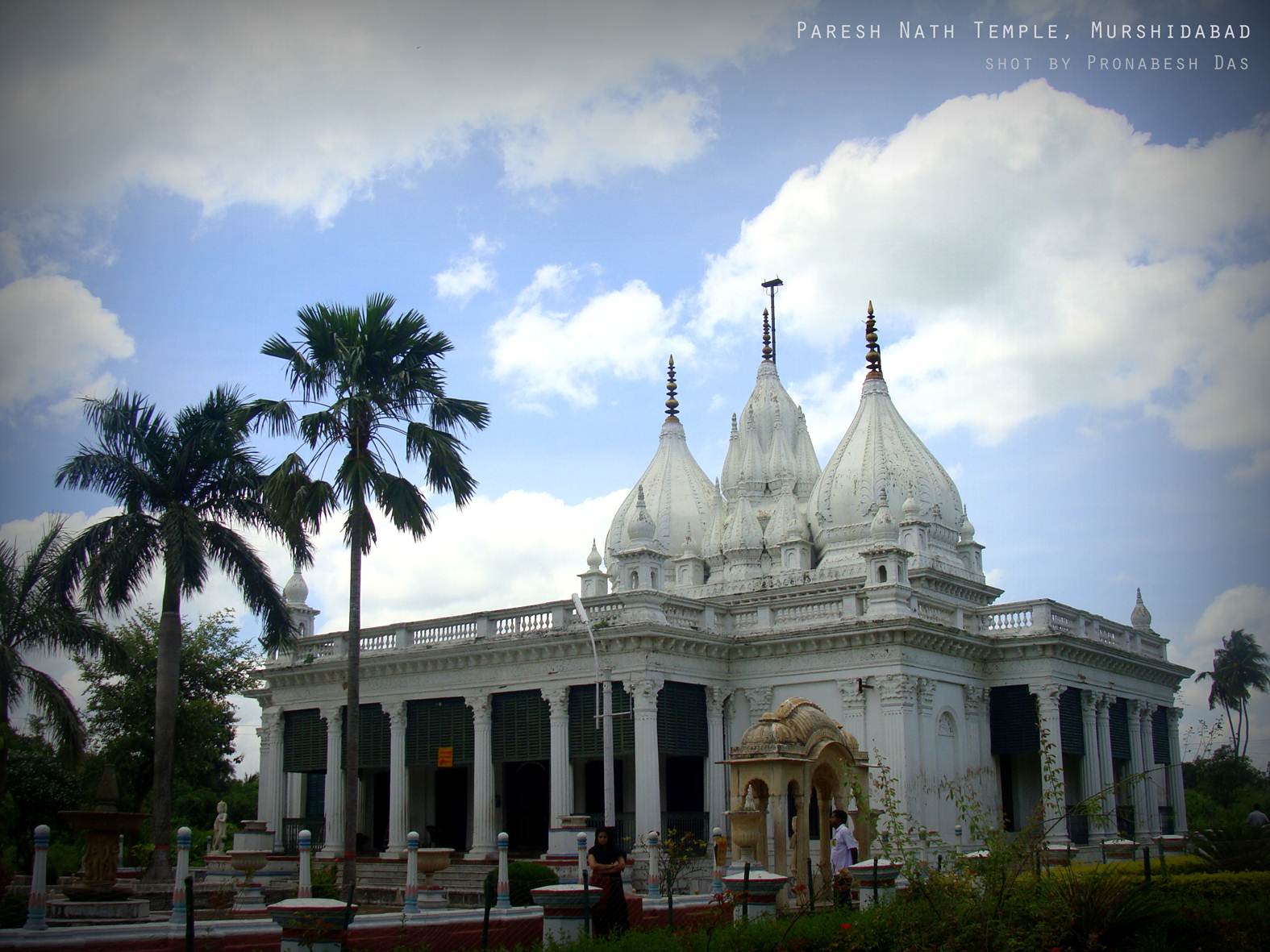
Under strict orders, I had to take out my shoes and cameras were not allowed inside, so I didn't go inside the temple.  Kush, Sugata, Debsathi and Mousumi went in and later described it to me. Standing outside, me and our guide- Mr. Sorkar had a little views exchange on the state of tourism of the town and the maintenance of the remnants. He told me that the tourism ministry is not totally ignoring the spots, but is surely capable doing its job better.

Then we went to the HOUSE OF JAGAT SETH, the Mahajan (and alleged co-conspirator of the murder of Siraj ud-Daula). Saw a pair sarees made of the world famous Muslin silk, common household  and business instruments used back then, a 400 years old Belgian glass mirror, a sensual portrait of the then famous 6'2" tall dancer Hirabai  and this underground passage to i-dont-remember where.

Next stop was NASHIPUR PALACE. Initially the place seemed to belong to a philanthropic zamindaar.
But as Sherlock Holmes has said, "It is a capital mistake to theorize before one has data" I had to change my opinions once I came face to face with the facts of the building.

No need to use one's imagination on what happens when a merciless dacoit is made the revenue collector of the zone. (what was the Nawab thinking?!). By misappropriating the state taxes, he had build a huge palace for himself. The taxes were collected by inhuman means too. The defaulters were brought to the palace and were locked up in a dark cellar, only to be executed by hanging on a pre-fixed date in the Phansi Ghar (the Hanging Room) of the palace. Our guide even showed us the gargoyle through which the blood used to flow out to the outer sewer during the annual sacrifice ceremony, human sacrifice.
And, not surprisingly enough, Debi Singha too, during his last days, started to regret all that he did during his last days. But he did not chose to get below the feet of people. He chose to rather please the Gods. He made a whole compound  of temples for all the Gods he could remember from the Hindu mythology. Grandest of which was that temple of Radha-Krishna (which is just adjacent to the Phansi Ghar).
This seemed truly funny. All your life, you do all the evils one is mortally capable of for your very own greed and at the end, make an array of temples or get under the staircase to nullify them. How easy!
Then was the little spot where the history of our nation took its turn. The spot where the last free Nawab of Bengal was killed by his own men - Mir Jafar and Mohammad-e-Begh. The NAMAK HARAAM DEWRI. This hammered in the last nail in the losing of the Battle of Plassey and the start of British regime in Murshidabad, then through Calcutta, in India.

From end to end, all the tourist places are in a span of less than 7 km in the area of Lalbagh. A song of normal length (played in the car's deck) was stretching for two to three spots. At 2 in the afternoon, we stopped to have lunch. And there was no surprise that when Kushanava, Sugata and Pronabesh are having food together, the stipulated budget is at least exceeded. The day had roasted the right side of my face and made a tandoori of the left side. But still, we had the biggest attraction Murshidabad left. Under that weirdly cloudy sky and the strength-confused sun rays, we reached the HAZARDUARI.
The palace of more than a thousand doors (true and fake combined), stands as a symbol of the British colonial rule on the later Nawabs of Bengal. Previously used a courthouse for the three provinces of Bengal, Bihar and Orissa, this is now a museum housing a magnificent display of Nawab's armory and luxury. Leaving our cameras outside, we took the tour of the palace only to be awestruck by the merciless daggers, trick mirrors, ivory palanquins, royal furniture, collection of  handwritten real historic letters and documents and what not.

Just opposite to this palace is the Ghadi Minar or the Clock Tower and the BADA IMAMBADA, India's longest Imambara till date.
Giving a rest to our aching feet, the crew sat on the stairs of the Hazarduari palace admiring the remains of the grandeur of whatever is left of the Nawabs.
While walking towards the Bhagirathi (the Ganges) flowing by the boundary of this area, a complete rainbow (not in this picture) in the midst of the dark clouds and the bright sun did a good job in giving us a complementary thing to see. And nothing suits your walk better than a little bit of nostalgia.

Looking at the century old design of the horse pulled carts, a seat on the edge of that fishing vessel parked in the water, missing a few people on the trip, missing a few people in general in the setting where history is scattered all over the place. Yes, without a tired body you cannot appreciate these things. Guess, everything has an advantage.


The evening at the hotel was high on stories of supernatural (gods and ungods were equally present). And the worst effect of this was on Mousumi (she found it hard to fall asleep before 5 in the morning) and me (I, after a long time, was talking in my sleep). A jackpot sleep was reported by Sugata. Kushanava was anyway eager to fall asleep before dinner but once he finally did (after dinner and with a bad throat), he was reported to play football in his sleep.

Anyway, next morning we had only one place to touch - the KHUSHBAGH, the tomb of the famous Siraj-ud Daula. After assassinating him at Namak Haraam Dewri, his body was cut into six pieces and was taken around the city of Murshidabad for display.
After, the devilish satisfaction of those who found it amusing, Siraj was taken on the other side of the Bhagirathi and was buried at this place. After him, all his family members and associates were also buried in this place. Our curiosity on the supernatural was aroused once more here when the rickshaw puller here told us that the locals here used to hear the 'wailing of the Nawab' about 15-16 years back. I am not sure, how true was that, but I had no problem in digesting it as a nice story.
At times, Mousumi was remarking about the place "its just tombs and tombs". Initially, it sounds a bit waste of money to come and see only tombs - torturing rulers, victimized civilians, tombs of people sealed in them alive. But if one sits and looks at them as a reflection of the history, one can truly become depressed on what actually has paved the path of the society we live in today - slavery, greed, conspiracies and death.

My personal take on a place like Murshidabad is - Lesser such places on earth, the better.

Nevertheless, I had a fantastic weekend and wish to see more of my land :-)

Till next time,
Cheers! :-)

Wednesday, July 11, 2012

Clouds, Rain and Mandarmani

First thing first...

“Mrigank, Malobika, Avisek, Jayasree, Manoj, Jyoti, Kamalendu,
Thank you for the trip. I mean it.”

A quick thought at the office in the middle of the week, some quicker agreements, some useful research, balancing the budget and in the end all was set for Mandarmani. Eight heads but more than just eight hearts. The week finally ended and Kolkata saw our waving hands when we rode NH6 towards Kolaghat. From there, NH41 till Nandakumar and from Nandakumar SH4 to a cross road called Chawlkhola. From there a 15km drive southwards to Mandarmani.

The weather overall could not have been better. To everybody’s delight it rained a very soothing and balanced amount and people expressed their agreement with the meteorological thoughts of the sky of West Bengal by trying to suppress the voice of the singers from the car’s music system with their own (in a good way).

A totally energy filled four hours and we were at our beach resort. Once the bunch had witnessed the water, it was very hard (even for a hydrophobic like me) to stay away from it. During the high tide hours, the water is at the very footsteps of the resort. Needless to say, I put my camera to rest and joined in the party. The waves are of the perfect height for sea bathers and if one is only able to stay away from those submerged boulders during the high tides, it is a very (very) refreshing experience (duh!).

I came out of the water before anybody else as the clouds had now stopped making those marvelous patterns. I wanted to capture those which were still left in the view.
-->
After everybody was out of the water (and dried off) and had a good lunch, the exploration of the beach begun. The water had now receded and a good width of the sandy stretch between the sea and the hotel was available for us to walk.

-->We had more than two hours with us before we had to place the order for dinner. (before 7 in the evening you have to place that so that things get ready by 9). Now everybody was only enjoying the atmosphere. Some the wind, some the drizzle, some the lonliness.

-->Suddenly, when the we-are-in-a-group air came back we all decided to take an almost  a kilometer long ride in those motor operated van rickshaws to explore the coastal stretch a bit more. The most magnificant thing that I was lucky enough to witness was the reflection of the clouds. I have seen glamorous sunsets on various beaches, but such a magnificant overcast weather was a first time experience.
The group I was with, strangely enough, was not busy in getting themselves photographed much here. There is a strange urge in everyone of us to tell the world – "look, I was here". But in that evening I think, it was more about inhaling the atmosphere of Mandarmani than making arrangements of the proofs of travel.
To be able to meet that ‘only me’ in that wide open space does take you a little above the tangled materialistic thoughts. (Although, this was more powerfully experienced by me later, the next morning. Will come to it).

-->
By the time we were back, without witnessing a proper golden sunset, we saw the entire sky (and its reflection on the earth and sea) turning pure blue. Upon looking at this picture, one of my friends had said: "It feels sad". Truly speaking, the colour  did bring out a little of those violin strokes from my past too which have still remained unbalanced.

When it grew darker, my camera finally displayed an empty battery and signalled me to actually join the group to enjoy a tea in that breeze. After the tea and snacks, Avisek, Kamalendu, Manoj and I had a funny ordeal in the rain to find a particular way, via a bus stand, and then to get back to our hotel. Once back, all of us had a fantastic adda-cum-bakwaas session at the top of the resort's sliding board (ssilip as it got termed later among us). After the dinner, the session took place On the Rocks during the High tides.

-->
Next morning, I was the one to wake up first and go out in the beach to see sunrise. Sadly it was still cloudy. But I was lucky enough to carry my music player with me when I went out in that ungodly hour.
When you are alone in that first light of the day with such an open space all around you accompanied by the most final sound for a land dweller, the waves, you truly start to believe that there is someone called you, exists. It is not a feeling of lonliness that creeps inside you, but a feeling of love for some simple facts like “yes, I too can see, I too can listen”. And half of the credit for such a feeling goes to the poetry (called Imran’s poetry) being played in my music player then. Written by Mr. Javed Akhtar, narrated by his son Farhan Akhtar from the movie Zindagi Na Milegi Dobara. I know how I kept my aching throat under control. But the eyes were tougher to tame. Thankfully noone was close enough to make me feel embarrassed.

-->Before the rain started for the day, I got a little time to explore the shore. The water again had went back during the night. There were water holes like this all over the beach which, upon having a closer look, were giving away some curios forms to see.

-->
After some more time, the rain started. The hotel had open shades with straw roofs facing the beach. It was a treat to just sit there getting a little wet with the rain carried in by the wind, listening to some music, talking to a few starngers about the good and bad of the place, sharing a few jokes with them and looking at the sea through the falling droplets.
 
-->Everybody else from our party started to wake up gradually. It was raining rather a bit heavily but the satisfaction after a perfect sleep on everybody’s face was making it sunny enough. People are stressed enough in office. The morning made the break look a well deserved one.

During breakfast, we got the news that the rain has worsened the road to Mandarmani Mohona which we were planning to visit after checking out. So, we decided to go to the Digha Mohona instead. Mohona is a Bengali word for the place where a river meets the sea, a canal mouth. It took a drive of about half an hour to reach this place.
-->
-->
I dont know which river exactly comes and meets the sea here (nor I did any research), but whichever one does, does turn really wild upon meeting with its superclass. It starts to show waves in itself and it becomes very difficult to say, more so during the high tides, where it seizes to become a river and starts boasting of being Bengal's Bay.
-->
But this was not all. A path made of concrete blocks goes a little inside the waters and our party was lucky enough to see the wild side of the untamed shore. Most of our cloths got wet with the random slaps of the waves on the block, but if you are able to keep your cameras dry, you would find the experince of standing on that four feet wide way amusingly thrilling.

-->
After getting my jeans completely splased with the sea water, I decided not  to stay there anymore. There were water drops seen on the sensitive areas of my camera too. So, for the sake of that device I headed back to our vehicle.

-->
The place basically serves as a wholesale market for fishermen and the traders. One reaches the Mohona after walking through the huge market (a walk of roughly five minutes).
There is a road wide enough for a vehicle to pass easily but believe me when I say, you will be able to inhale some air only when you have reached in front of the gent’s saloon in the middle of the market which smells of shaving cream and aftershave. During rest of the road, its better that you hold your breath.
From the Mohona, we went a little ahead to the town of Old Digha. There was a long photo session there also, then there was a bargaining chapter for cashew nuts and then a lunch.

Thanks to the decision by Kamalendu to bring a USB drive stuffed with some fabulous songs and the occasional stunt-driving by our driver on the highway, we had no trouble in staying awake even on our journey back to Kolkata. The ladies although enjoyed a short post lunch nap but I am sure hey were finding it rather difficult due to the noise-over-the-cards in the rearmost seats by the other boys.

Roughly around 5 in the evening, we were closing Kolkata. On passing the last toll-gate, the sight of the Vidyasagar Setu with that clear sky in its backdrop filled in a sense of relief. No matter where I go and how much I enjoy the entire tour, the feeling of “yes, I am home now” is the most relaxing one.
Must say, this Mandarmani trip was much more fulfilling than a few more I had taken in the past. If you guys get some time, you can try out this place. But be sure to pack your best buddies, your good health, your camera, your music player and if you want, your alarm clock!
-->
Till next time,
Cheers! :)